

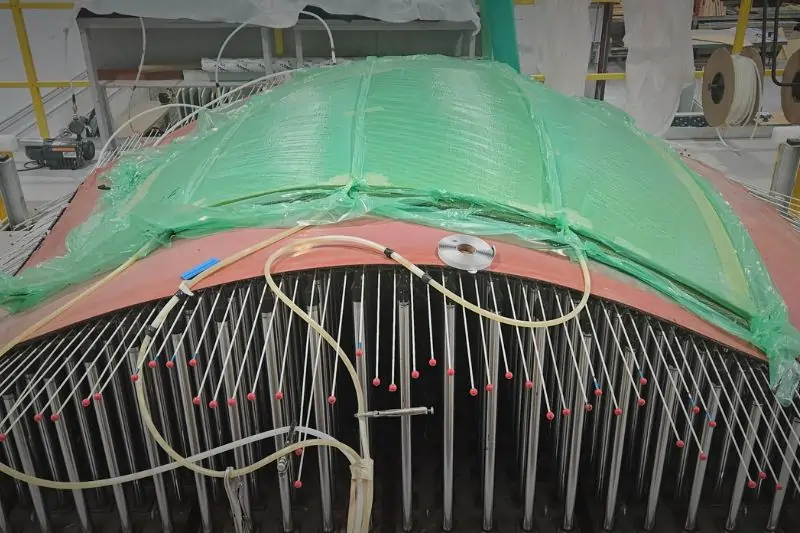
Composite materials are increasingly used in the naval, aerospace, automotive, and construction sectors. The manufactured parts stand out due to their mechanical properties—particularly their strength, flexibility, and durability. Now imagine a technology capable of producing curved composite panels. This is made possible through adaptive molds. They offer numerous advantages over traditional molds, especially in terms of geometry, and open the door to a wide range of applications.
Adaptive Molding: Quebec as a Key Player on the Global Stage
Quebec’s manufacturing sector stands out internationally thanks to its access to adaptive molding technology, which is still relatively rare. In fact, BeSpline, located in Sherbrooke, is the only company in North America with this manufacturing process. This equipment, measuring two by three meters, is powered by 600 electric actuators that shape a flexible silicone membrane into a desired form. Panels are then thermoformed to create composite parts with varying geometries, with curvature radii reaching up to 350 mm.
Whether single or double curvature, the geometric flexibility offered by adaptive molding reduces the cutting and assembly steps typically required in traditional processes. This results in several benefits, particularly in terms of mechanical properties such as strength, durability, and watertightness. Another key advantage is that this technology does not require the fabrication of molds or dedicated tooling. Moreover, the adaptive mold can take on multiple shapes within minutes. These factors make it an attractive solution both environmentally and economically.
“In terms of productivity, adaptive molding can reduce production time by up to 60% compared to traditional processes. Parts can be 25% lighter and up to four times stronger,” explains Yoann Bonnefon, CEO of BeSpline.
Finally, adaptive molding has no technological limitations regarding material selection (laminated wood, thermoformable foams, bio-based resins, natural fibers, recycled materials). This versatility makes it suitable for a wide range of industries.
A Game-Changing Technology for Multiple Industries
Demand for curved panels and components in architecture continues to grow. For example, at Kuwait International Airport and the Museum of Dubai, this technology enables countless possibilities, including interior design elements such as staircases, curved tracks, suspended ceilings, and acoustic panels. Projects are expanding rapidly, both in Quebec and Europe. Free-form curves, organic shapes, and the lightweight nature of composite materials make this technology especially attractive.
Adaptive molding is also well suited to the maritime sector, particularly for manufacturing boat hulls and decks with complex geometries. These structures are typically made of fiberglass and resin. Traditionally, shaping these materials involves bending them, which creates open channels—often called “kerfs”—within sandwich structures. To address this issue, resin injection is required to fill these grooves, increasing both weight and cost. Adaptive molding eliminates these constraints by producing, for example, curved foam panels (styrene-acrylonitrile [SAN] and recycled polyethylene terephthalate [PET]) up to two inches thick.
The aerospace sector faces several challenges. Parts are often customized or produced in small batches and must combine strength, lightness, and durability while meeting strict cost and production time requirements. Whether for flight simulators or aircraft interior components, adaptive molding enables the production of complex geometries three to five times faster than traditional methods. Combined with advanced composites, it can reduce part weight by 50% to 80%. Additionally, the absence of molds or specialized tooling makes small-batch production more cost-effective.

A Technology with Strong Future Potential
Today, adaptive molding is used in the naval, aerospace, and construction sectors. However, its potential extends far beyond, including:
- Motocross tracks: Traditionally, motocross tracks are built by dumping and shaping large volumes of soil—a labor-intensive and costly process. In collaboration with Sherbrooke-based company X-Track, BeSpline is developing innovative track modules made from composite panels mounted on aluminum frames and covered with aggregate surfaces. These modules can be easily assembled, disassembled, and relocated. This concept could also be applied to other sports, such as cycling tracks.
- Immersive display solutions: As immersive technologies rapidly evolve, adaptive molding offers an ideal solution for creating projection surfaces. With lower costs and shorter production times, it enables the manufacturing of slightly curved composite panels that can be assembled into large, seamless immersive environments for visual projections and simulations.
In summary, adaptive molding offers not only greater design flexibility but also improved productivity and reduced labor requirements, all within an environmentally responsible framework. Ongoing research is also focused on developing composite panels made from plant-based fibers (such as flax) and bio-based or recycled materials. This presents a compelling opportunity for manufacturers seeking to innovate, develop proof of concepts, produce small batches, or enhance their competitive edge—while contributing to sustainability.
By Fanny Charreteur
This article has not undergone thorough linguistic review. It may therefore contain some spelling and syntax errors. Rest assured that the nature of the content and information presented is not affected.

