

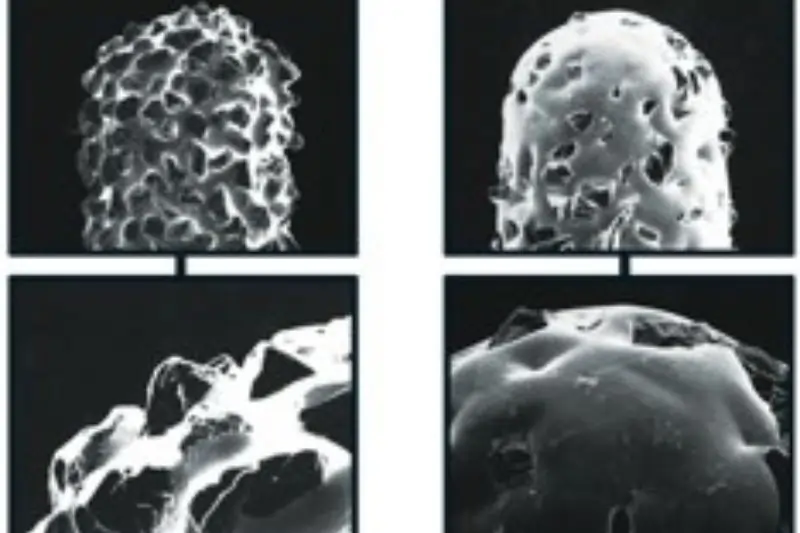
Did you know that abrasive products are also evolving to meet new manufacturing trends? New abrasive products developed using diamond-plating technologies are gaining increasing attention. These technologies help improve both the productivity and efficiency of sanding and surface-finishing operations on reinforced materials containing glass fibers, as well as harder fibers such as carbon, ceramic, and even metallic fibers based on boron or alumina.
Two technologies stand out in particular for the composites industry: brazed diamond technology (P.B.S.®) and polycrystalline diamond (PCD) plating technology.
P.B.S.® Brazed Diamond Technology
The Plating Bonding System (P.B.S.®) technology offers numerous advantages for machining non-metallic materials such as composites. It uses diamond crystals that are strategically positioned to maximize their exposure and cutting efficiency. This configuration enables faster material removal, significantly improving productivity.
In addition, the arrangement of the crystals helps reduce heat generation, abrasive tool loading (clogging), and diamond grain loss during sanding operations. Unlike conventional diamond abrasives, which are typically attached through electroplating processes, P.B.S.® technology permanently fuses the diamond abrasive to the tool, providing a much stronger bond.
Furthermore, the enhanced exposure of the diamond crystals increases the abrasive’s cutting action on the work surface, allowing superior results to be achieved in less time. Tools incorporating P.B.S.® technology can also be cleaned more easily than conventional abrasive tools using an organic solvent.
P.B.S.® brazed diamond abrasives are available in a wide range of tool formats to meet virtually all sanding and machining requirements. These include profiling wheels, saw blades, drill bits, grinding wheels, core drills, surface-conditioning discs, and chisels.
These tools can also be custom-designed in specific sizes and configurations to meet demanding applications and tight tolerance requirements. In addition, worn tools can be refurbished by replacing the diamond abrasive layer after extended production use. This restores the tool’s original performance and efficiency, providing the productivity of a new tool while improving cost-effectiveness.
This refurbishment capability also helps reduce waste and supports a more sustainable manufacturing approach by minimizing the environmental impact associated with tool replacement.
Polycrystalline Diamond (PCD) Coating Technology
The growing adoption of automated and robotic manufacturing processes often requires the use of high-performance tools, such as those incorporating Polycrystalline Diamond (PCD) technology. PCD is a synthetic diamond material composed of diamond particles fused together under extremely high pressure and temperature conditions.
The structure and geometry of polycrystalline diamond crystals enable high-speed plunge cutting and drilling operations while maintaining exceptional precision and surface finish quality. In addition, PCD technology reduces the risk of tool delamination and wear, helping to lower maintenance costs and minimize production downtime.
PCD tools are available in a variety of configurations to meet the diverse needs of industrial applications. These advantages make polycrystalline diamond tools an essential solution for automated and robotic manufacturing processes, particularly in the machining and finishing of composite materials.

The Importance of Consulting an Abrasives Expert for a Tailored Solution
Every company has unique sanding and machining requirements and should not rely solely on one-size-fits-all solutions. To maximize equipment performance and improve operational efficiency, it can be highly beneficial to have your processes evaluated by an abrasives specialist.
An expert can assess your current operations based on the materials being machined and identify opportunities for improvement. Through a personalized approach, they can recommend solutions specifically tailored to your manufacturing environment, helping you optimize productivity, quality, and overall operating costs.
Disclaimer
The information provided in this article is intended for general informational purposes only. The author assumes no responsibility for any consequences arising from its use. Readers are responsible for verifying that the information is suitable for their specific application and does not present any risks before implementation.
The content presented herein should not be construed as specific recommendations or professional advice. Because every situation is unique, a customized evaluation is necessary to determine the most appropriate solution.
By Julie Arcand. special collaboration
Julie Arcand is President of Les Abrasifs EA Inc. (jarcand@abrasifsea.com).
This article has not undergone thorough linguistic review. It may therefore contain some spelling and syntax errors. Rest assured that the nature of the content and information presented is not affected.

