

In a global environment marked by geopolitical instability, rising trade tensions, and increasing pressure on supply chains, the defence sector stands out as one of the few stable drivers of growth.
In Quebec and across Canada, governments now recognize this potential and are stepping up their commitments. Ottawa recently unveiled a major investment plan providing more than $9.3 billion in additional funding to modernize the Canadian Armed Forces, diversify procurement partnerships, strengthen domestic industrial capacity, maintain aging equipment, and enhance the Department of National Defence’s digital capabilities (1).
The Quebec government has also announced several investments in the defence sector, including $10 million in support for the development of space technologies. This funding will contribute to the development of Reaction Dynamics’ hybrid propulsion system, in partnership with Maya HTT, a member company of Alliance Polymères Québec. The system will enable microsatellites to be launched into orbit from Canada (2, 3, 4).
These investments clearly signal that Quebec’s plastics industry could play a central role in the next cycle of strategic development. For manufacturers, the challenge is therefore not simply to keep pace, but to position themselves at the heart of this shift.
In this demanding market, there is real strength in collaboration. By creating greater collective value, Quebec’s plastics industry can secure a strong position within the defence sector.
The Defence Market: A Value Accelerator
History has shown that defence has always been a major driver of innovation. Synthetic fibres, engineering plastics and advanced composites all gained momentum through military applications before expanding into civilian markets.
Today, every performance improvement translates directly into strategic value:
- One kilogram less in an armoured vehicle reduces fuel consumption and increases range.
- A more durable component lowers maintenance costs, increases operational availability and provides better protection for personnel.
- A stealthier system can significantly enhance tactical superiority.
From this perspective, plastics and composites are more than just materials: they become key drivers of value creation, directly contributing to military performance.
For Quebec companies, entering this market means not only gaining access to new revenue opportunities, but also strengthening their international profile by demonstrating their ability to meet some of the world’s most demanding standards.
Quebec’s Plastics Industry: Three Complementary Strengths
Plastics (High-Performance Thermoplastics)
Advanced thermoplastics such as PEEK, PEI and PPS are already being used in the aerospace and marine sectors. Their lightweight properties and resistance to extreme temperatures make them well suited for ducts, aircraft interior panels, drone components and embedded systems.
In addition, 3D printing, which is experiencing rapid growth in the defence sector, offers a strategic opportunity for plastic materials. The ability to quickly produce customized parts close to operational areas reduces lead times and inventory requirements while strengthening logistics resilience.
Composite Materials (Reinforced Thermosets)
Thermoset composites reinforced with carbon, aramid or UHMWPE fibres are paving the way for ballistic, stealth and ultra-durable solutions. For defence applications, they can enable lighter armour, modular drone structures and durable naval components.
Quebec already has advanced expertise in the formulation, moulding and prototyping of high-performance composites. By combining and leveraging these capabilities, the industry can address growing global demand for higher-performance, more durable equipment.
Moulds and Tooling
Often overlooked, the mould and tooling sector is nevertheless a critical link in the value chain. Defence prime contractors are looking for solutions that can be rapidly scaled up for industrial production. Quebec is already recognized for its expertise in designing complex, high-precision moulds.
Integrating this expertise into a coordinated offering would make it possible to provide not only the material or component, but also the capacity to manufacture at scale with the quality, consistency and repeatability required by military standards.
High-Potential Sectors for Quebec
Naval

Naval construction and modernization are expanding rapidly, both in Canada and allied countries. Needs range from corrosion-resistant composite components to intumescent polymer coatings designed to provide protection against fire and heat.
Quebec has the potential to become a key partner by offering modular solutions for fleet maintenance, as well as lightweight components that enhance vessel stealth and energy efficiency.
Aerospace and Drones
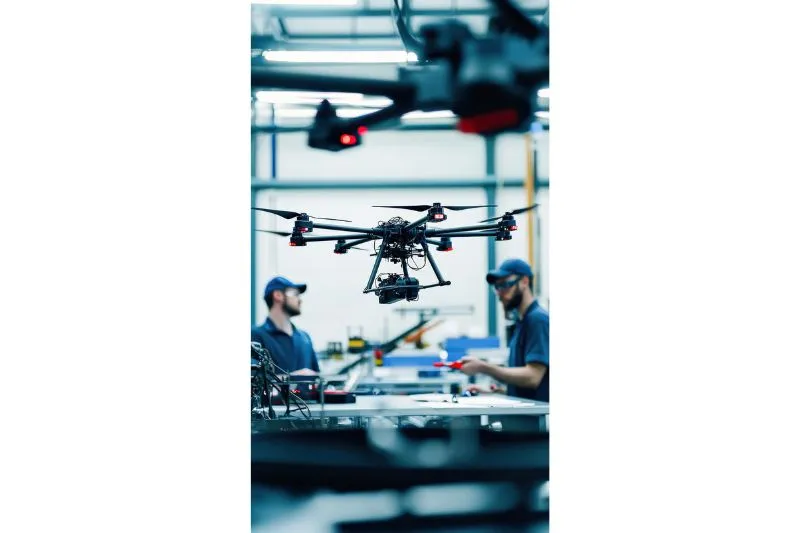
Already recognized worldwide for its aerospace expertise, Quebec has a strong industrial and research base. Opportunities are numerous, including lightweight interior components, complex thermoplastic ducts and composite structural components.
Drones represent an even more promising sector. Whether for military or civilian applications, their use is expanding rapidly in surveillance, reconnaissance and logistics. Their material requirements are significant, ranging from modular structures and stealth fairings to integrated sensor systems. Quebec already has leading players with the expertise to design and manufacture these components.
How to Stand Out: Beyond the Product, an Integrated Offering
The risk for Quebec companies is approaching the market individually, each with a specific product or process. However, major customers—including defence departments and prime contractors—are primarily looking for complete solutions.
This requires:
- Materials certified to military standards.
- Industrial security certifications.
- Reliable and repeatable manufacturing processes.
- Rapid production scale-up capabilities.
- Integrated and resilient logistics.
The key to success is therefore to build commercial alliances that bring together expertise in plastics, composites and tooling. By combining a range of manufacturing processes, tooling design capabilities and smart sensor integration, Quebec companies can deliver turnkey solutions that simplify procurement and provide greater value to prime contractors.
Market Access Strategies
How can this potential be turned into actual contracts? Several strategies are essential:
- Build consortia: Bring together Quebec expertise to jointly respond to calls for tenders.
- Engage research centres: CCTTs, universities and other research organizations should become key partners in developing and validating solutions.
- Leverage federal programs: Take advantage of Canadian defence procurement initiatives and North American partnerships to secure a position in defence supply chains.
- Invest in international marketing: Increase Quebec’s visibility at specialized trade shows, in industry publications and across global business networks.
The message is clear: rather than waiting for the market to come to us, we need to pursue it proactively, strategically and with a coordinated approach.
Quebec: A Credible and Essential Partner
Quebec already benefits from several distinctive strengths:
- Recognized expertise in plastics, composites and moulds.
- Innovative companies capable of delivering quickly and reliably.
- Geographic and cultural proximity to the United States, the world’s largest defence market—although this advantage must be approached with caution in the current context.
Indeed, the Trump administration has reintroduced additional tariffs of up to 25%, and in some cases 35%, on certain products imported from Canada (5). These measures make access to the U.S. market more challenging, reducing the comparative advantage of geographic proximity. In other words, while the southern border remains a logistical advantage, it no longer guarantees seamless market access.
Quebec companies must therefore develop alternative sourcing scenarios, diversify their markets and leverage local excellence to differentiate themselves.
The opportunity also extends beyond securing individual contracts: it is about contributing to the industrial sovereignty of Canada and its allies. By reducing dependence on imports and providing innovative, locally developed solutions, Quebec companies can position themselves as essential strategic partners.

Aiming Higher in an Unstable World
The defence sector currently represents a rare and strategic opportunity for Quebec’s plastics industry. Demand is substantial, budgets are growing, and expectations are clear: performance, durability and integration.
But the key is not technology alone. It is also strategic and collective. By joining forces, building strong commercial alliances and offering integrated, high-value solutions, companies across the three sectors—plastics, composites and tooling—can successfully compete in this demanding market.
There is strength in unity. By speaking with one voice and presenting a diversified yet cohesive offering, Quebec’s plastics industry can turn its strengths into tangible contracts and strengthen Quebec’s position on the global stage.
The time to act is now. In the defence sector, standing still means falling behind—and Quebec has all the assets it needs to move forward.
And it goes without saying that Alliance Polymères Québec is the ideal partner to support companies looking to join forces and break into this rapidly expanding market.
By Simon Chrétien
- https://commercemonde.com/2025/06/impact-de-la-hausse-du-budget-de-la-defense-le-quebec-a-laube-dune-transformation-industrielle/
- https://infobref.com/defense-quebec-legault-2025-06/
- https://quebec.ca/nouvelles/actualites/details/investir-dans-le-secteur-de-la-defense-et-de-la-securite-33-m-pour-la-production-de-systemes-electro-optiques- pour-la-defense-63502?
- https://quebec.ca/nouvelles/actualites/details/quebec-investit-dans-le-secteur-aerospatial-10-m-pour-une-technologie-de-lancement-de-satellites-63517
- https://www.whitehouse.gov/fact-sheets/2025/02/fact-sheet-president-donald-j-trump-imposes-tariffs-on-imports-from-canada-mexico-and-china/
This article has not undergone thorough linguistic review. It may therefore contain some spelling and syntax errors. Rest assured that the nature of the content and information presented is not affected.

