

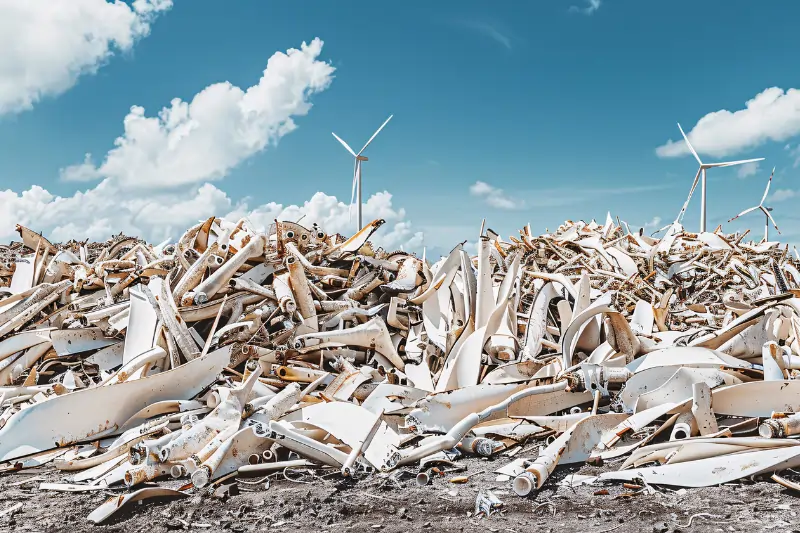
Composed of a matrix—generally organic (polyester resins, phenolic resins, polyamides, etc.)—and a reinforcement (glass fibers, carbon fibers, natural fibers, etc.), composite materials are increasingly used across many industries, including automotive, aerospace, construction, and energy. They provide components with strength, durability, and lightweight properties. Across all material types, global composite production reached 17.7 megatonnes in 2019 (1). This market, valued at over $90 billion, is expected to grow significantly in the coming years. However, the environmental impact of composite materials is far from negligible. In addition to the highly energy-intensive production of glass and carbon fibers, most resins are derived from the petrochemical industry. Production scrap and end-of-life products must also be considered. For example, in 2020, wind turbine blades generated 30,000 tonnes of waste annually worldwide, a figure expected to triple by 2025 (1). These are significant numbers, especially considering that most composite waste is landfilled. Several factors explain this approach, including relatively low volumes compared to other materials (such as plastics or steel) and dispersed waste streams that make collection complex and costly. Nevertheless, in recent years, momentum toward recycling composite materials has clearly increased.
Recycling Composite Materials to Address Environmental and Economic Challenges
Whether by reducing landfill waste or lowering the energy consumption associated with producing virgin materials, recycling composite materials is undeniably a climate issue. Moreover, given uncertainties surrounding raw material availability, rising energy costs, and the increasing price of carbon fiber, this strategy also offers economic advantages—not to mention the jobs created through the development of this sector. However, recycling composite materials presents several technical challenges. Recycling and recovery processes must not alter or degrade the mechanical properties of the material, and the complex physicochemical properties of composites (melting temperature, miscibility, solubility, adhesion, etc.) must be carefully considered. Several methods are available, each with its own economic and technical advantages and limitations.
Research Projects Focused on Composite Recycling
Since 2020, Martine Dubé, a professor in the Department of Mechanical Engineering at the École de technologie supérieure (ÉTS Montréal) and holder of the Marcelle-Gauvreau Research Chair in Environmentally Friendly Composite Materials, has focused her research on developing processes for recycling these materials. With the ultimate goal of deploying solutions in industrial settings, economic considerations have been carefully analyzed, taking into account scrap characteristics, matrix and reinforcement properties, and final applications.
“The recycling process for composite materials must not only address financial constraints but also meet the technical requirements of the final part. Industry must see a clear benefit,” explains Martine Dubé.
In this context, the Chair’s work has been structured around several research axes:
Recovering Production Scrap
According to Martine Dubé, the production of carbon fiber prepreg thermosets generates up to 10% scrap. Once collected in rolls or offcuts, the material is cut or ground to achieve more uniform fiber lengths. The resulting plates or powders can then be processed through compression molding, injection molding, or additive manufacturing. As noted by Ilyass Tabiai, professor in the Department of Mechanical Engineering at ÉTS, whose research focuses in part on forming high-performance composites:
“Our department has access to state-of-the-art equipment, including a six-axis robotic arm. This allows us to overcome many geometry-related constraints during processing.”
However, this approach has limitations. Mechanical processing causes fiber discontinuity and does not allow separation of the constituents, which inevitably affects composite properties. As a result, these materials are suited to applications where high strength is not critical, such as shower bases or aircraft interior components.
“To improve mechanical performance, we are also developing composite materials that incorporate virgin polymers into the ground powders derived from production scrap,” adds Martine Dubé.
Recycling End-of-Life Composite Materials
Composite materials are widely used in aerospace and energy sectors, but their lifespan is limited. Martine Dubé’s team is working on recycling aircraft structures made of thermosets and carbon fiber. To separate fibers from resin, pyrolysis or solvolysis processes are used. Once reprocessed, these recycled materials can be used to manufacture new parts while maintaining excellent mechanical properties.
Let us now cross the Atlantic to Europe, where Polish industry players and Dutch researchers are focusing on reusing end-of-life wind turbine blades or developing new recycling methods depending on their level of degradation (2). The company Anmet, for example, has expanded its activities. A team of specialists travels directly to wind farms to cut blades made of thermosets and glass fibers. The pieces are then transported to the plant and, if their physical condition allows, reused to manufacture architectural products (outdoor furniture, car shelters) or infrastructure components (walkways, bridges, geotechnical blocks). The advantages? Reusing these end-of-life composite parts requires no transformation (such as pyrolysis or solvolysis), resulting in lower energy consumption, reduced carbon footprint, and cost savings. Moreover, the mechanical properties of the resins and fibers remain unchanged. This approach opens the door to new markets.
At Windesheim University of Applied Sciences in the Netherlands, research focuses on recycling damaged composite parts (wind turbine blades, boat hulls). Researchers are developing new technologies, including pultrusion. This process, which involves several steps (cutting, shredding, soaking, extrusion molding, heating, and curing), enables full recycling of end-of-life composite parts while preserving their mechanical properties. To date, this approach has been used to produce furniture, retaining walls, and guide beams.
Whether mechanical, chemical, or thermal, ongoing research is helping to identify the most appropriate recycling processes based on composite properties, final applications, and economic considerations. This eco-innovative approach represents a promising avenue for aerospace, marine, wind energy, and automotive industries. Beyond environmental benefits, it also helps address supply chain challenges and reduce costs associated with energy consumption and the purchase of virgin materials.

By Fanny Charreteur
This article has not undergone thorough linguistic review. It may therefore contain some spelling and syntax errors. Rest assured that the nature of the content and information presented is not affected.

