

It’s deeply ingrained in our minds: when we think of solar energy, the first technology that comes to mind is photovoltaics—the well-known method of generating electricity from solar panels. This technology is widely deployed and experiencing remarkable growth. Take, for example, the city of Lac-Mégantic, which launched Quebec’s first microgrid in 2021. This system includes 2,000 solar panels installed on 30 buildings, with storage capacity of up to 1 MWh of energy (1). This initiative aligns perfectly with the province’s energy transition plan. But did you know there are other ways to harness solar energy? Solar walls, a mature yet still underutilized technology, offer an effective approach to heating buildings—particularly relevant in Quebec, where winters are long and cold, and energy costs are a major concern.
You might question their effectiveness given Quebec’s level of sunlight. Let’s look at the numbers: on an annual basis, Montreal receives 1,580 hours of sunshine, compared to 1,815 hours in Regina, 2,180 in Cairo, 1,980 in Los Angeles, 1,251 in Paris, and 1,131 in Berlin. Clearly, solar energy remains a viable option in Quebec.
Solar walls… a simple principle
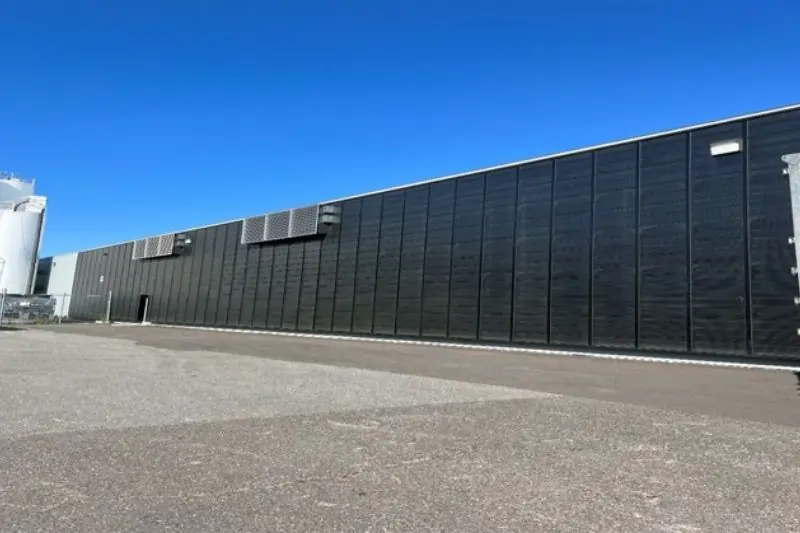
Installed on the sunniest exterior wall of a building, a solar wall consists of a solar collector or a dark-colored perforated metal cladding. Solar radiation is absorbed by the metal—typically aluminum, known for its low emissivity. The accumulated heat is then drawn through small perforations into the space between the solar wall and the building envelope. Fans subsequently distribute this warm air throughout the building. Since this technology relies on sunlight rather than outdoor temperature, it works effectively in both summer and winter. Its performance depends mainly on solar radiation intensity and wall exposure.
Not just an environmental solution…
By reducing greenhouse gas emissions, solar walls are clearly an environmental solution. This renewable and virtually unlimited energy source helps heat buildings while lowering reliance on fossil fuels or electricity. However, one limitation remains: heating needs are highest at night, when solar walls cannot generate heat.
From an economic standpoint, several factors come into play. Solar energy is free, meaning users are less exposed to fluctuations in energy prices. While maintenance costs are low, initial purchase and installation costs can be relatively high. That said, the return on investment can range from a few months to several years, depending on wall size, orientation, and building dimensions.
These characteristics make solar walls particularly well suited for manufacturing plants, warehouses, large institutions (schools, hospitals), agricultural buildings, and commercial facilities. Financial support is available to help adopt this solution, including Energir’s Solar Preheating Program and the Quebec government’s ÉcoPerformance Program.
Patrick Goulet, President of Énergie Solaire Québec, supports the deployment of this technology and notes: “These technologies have proven efficiency; large industrial facilities can achieve significant savings thanks to solar heating systems.”

A proven technology
Solar walls are not new. In 2011, Toyota’s production site in Valenciennes, France—committed to renewable energy and CO₂ reduction—installed a “SolarWall” system. Covering 400 m², this natural and sustainable heating solution reduced the building’s heating energy consumption by nearly 25%, while cutting CO₂ emissions by 20 tons annually. At the time, the investment was approximately €100,000, with a payback period estimated between two and seven years depending on weather conditions (2).
And there’s no need to look overseas for examples. Quebec is home to companies such as Trigo Énergies, Aéroénergie, and MatrixAir, all specializing in solar heating solutions and technological innovation. In Trois-Rivières, Groupe Bellemare installed a solar wall developed by Trigo Énergies. Under clear conditions, this system can raise air temperature by 10 to 25°C above ambient levels, while reducing natural gas consumption by approximately 20%. The financial and environmental benefits are undeniable (3).
A strategic opportunity for manufacturing
So, are solar walls relevant for the manufacturing sector? Considering uncertainties around electricity and fossil fuel costs, transportation expenses, and raw material availability, the answer is clearly yes. Quebec already has the expertise and industrial know-how to deploy these solutions. Combined with relatively fast returns on investment and low maintenance costs, solar walls represent a compelling and underexploited opportunity for the province’s manufacturing sector.
By Fanny Charreteur
This article has not undergone thorough linguistic review. It may therefore contain some spelling and syntax errors. Rest assured that the nature of the content and information presented is not affected.

