
The field of polymers is constantly evolving, as an enormous amount of research and development is being carried out worldwide at various levels (academic, governmental, and industrial). Although most of this work focuses on formulations (additives, reinforcements, blends, etc.), efforts are still being made to develop new molecules and/or families of resins. This is the case for a new class of polymer materials that has recently emerged: Vitrimers.
In 2011, the group led by Ludwik Leibler at the École Supérieure de Physique et de Chimie Industrielles de la Ville de Paris introduced the concept of “vitrimers,” a new class of thermosetting materials based on covalent adaptable networks (CANs) [1]. Below their vitrimer transition temperature (Tv), vitrimers exhibit the conventional behavior of crosslinked resins with excellent mechanical and thermal properties. However, above this temperature, these materials can be “melted” and therefore recycled. By definition, Tv represents the temperature at which the resin viscosity reaches 10¹² Pa·s [2,3].
Covalent adaptable networks contain reversible covalent bonds that enable the materials to respond to various external stimuli. These networks are classified into dissociative networks (dCANs) and associative networks (aCANs) based on their exchange mechanisms. In dCAN resins, such as polymers involving a Diels–Alder reaction between furans and maleimides, bond breaking occurs before bond reformation, which can compromise the material’s dimensional stability. In contrast, in aCAN resins such as conventional Vitrimers, the crosslink density is maintained throughout the bond-exchange process, making these materials more stable.
Basic Vitrimers are therefore a subclass of aCAN resins. To achieve this behavior, numerous exchange chemistries can be used, including transesterification, transamination, disulfide exchange, boronic ester exchange, transalkylation of triazolium salts, Schiff base exchange (imine chemistry), and many others [3]. These exchange chemistries can be implemented in various types of materials such as epoxies, polyurethanes, elastomers/rubbers, polyolefins, and benzoxazines.
Most exchange mechanisms are activated by specific catalysts, which imposes constraints on their application and limits their broader, large-scale adoption. Nevertheless, catalyst-free solutions, such as polyimines synthesized from aldehydes or ketones and primary amines, have been investigated because of the ease of imine exchange reactions initiated by heat. This therefore enables their chemical recycling through hydrolysis or transamination reactions.
In addition to their vitrimer transition temperature (Tv), Vitrimers also possess a glass transition temperature (Tg), and some vitrimers are semi-crystalline and therefore exhibit a melting temperature (Tm). In general, Tm lies between Tg and Tv. However, for amorphous vitrimers, two situations are possible: Tv > Tg or Tg > Tv [3]. In all cases, these transition temperatures can be measured using conventional techniques such as dilatometry, dynamic mechanical analysis (DMA), or differential scanning calorimetry (DSC).
For a more detailed characterization, it is necessary to determine both the number (similar to a crosslink density in thermosetting resins) and the energy (stiffness) associated with the dynamic covalent bonds that are formed (red-green interaction forces in Figure 1), depending on the atoms involved. Nevertheless, the exchange rates are extremely fast, on the order of a few nanoseconds (ns) [3]. These exchange rates are also temperature-dependent.
In practice, Vitrimers are considered a bridge between thermoplastic and thermosetting resins. Table 1 presents the advantages and limitations of each, while Figure 1 provides an overview of the structure and relationships between the different classes of polymers. It can be seen that the main differences lie in the intermolecular interactions in terms of crosslinking, which affects processing behavior and ultimately the ease with which the resins can be remolded and recycled. These latter aspects are now essential for viable solutions in sustainable manufacturing and the circular economy.


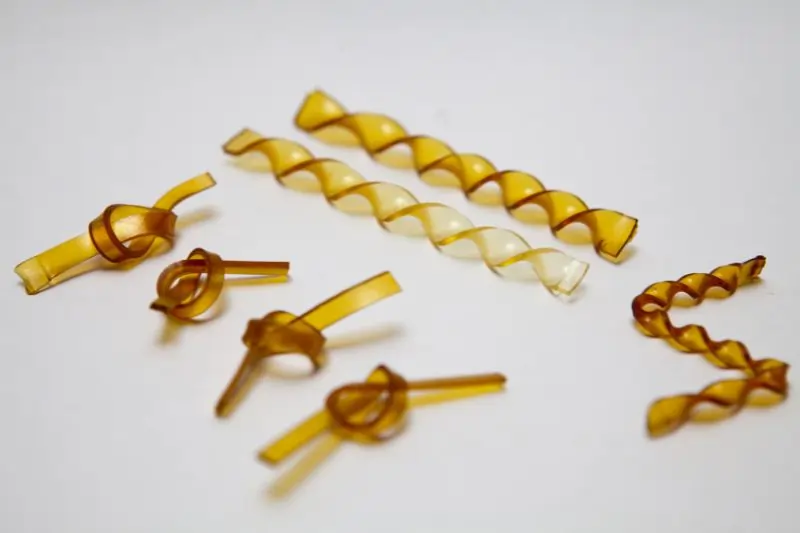
Due to their processing properties, Vitrimers can also undergo treatments to develop various functionalities such as self-healing, shape memory, and recyclability. In addition, research is underway to develop bio-based resins [6]. At present, very few resins are commercially available, but VITRIMAX is considered to be the first on the market [4,5].
For further information, readers may consult the Wikipedia page on Vitrimers [7], as well as the website dedicated to these new materials [8]. Since these resins are relatively recent, rapid developments are expected in the near future. Stay tuned!
Did you know that the word “Vitrimers” comes from the combination of the words “vitrum,” meaning “glass,” and “meros,” meaning “parts”? A vitrimer is therefore a material composed of several parts (monomers) that exhibits properties similar to glass.
By Denis Rodrigue, special collaboration
Denis Rodrigue, Eng., Ph.D., is a professor and researcher in the Department of Chemical Engineering at Université Laval (Denis.Rodrigue@gch.ulaval.ca).
- D. Montarnal et coll., Silica-like Malleable Materials from Permanent Organic Networks. Science, 334, 965–968 (2011).
- A. Veloso-Fernandez et coll., Improving the recyclability of an epoxy resin through the addition of new biobased vitrimer, Polymers, 15, 3737 (2023). https://doi.org/10.3390/polym15183737
- A.V. Karatrantos et coll., Molecular simulation of covalent adaptable networks and vitrimers: A review, Polymers, 16, 1373 (2024). https://doi.org/10.3390/polym16101373
- https://www.youtube.com/watch?v=kDL9wp6HoPI
- https://mallinda.com/product/
- H.T.T. Tran et coll., Recyclable and biobased vitrimers for carbon fiber-reinforced composites: A review, Polymers, 16, 1025 (2024). https://doi.org/10.3390/polym16081025.
- https://fr.wikipedia.org/wiki/Vitrim%C3%A8re
- https://vitrimers.net/blog/what-is-vitrimers/
This article has not undergone thorough linguistic review. It may therefore contain some spelling and syntax errors. Rest assured that the nature of the content and information presented is not affected.

