

With its Plan for a Green Economy, the Government of Québec has set a target to reduce greenhouse gas (GHG) emissions by 37.5% by 2030 compared with 1990 levels (1). Achieving this objective will require significant efforts, particularly in the transportation sector, which accounts for 44% of total emissions. In this context, green hydrogen—producing neither GHG emissions nor harmful environmental by-products—is considered a clean energy solution in the automotive, aeronautical, and aerospace industries.
In terms of production, hydrogen generated through water electrolysis positions Québec advantageously for integration into its energy system. The province benefits from abundant hydroelectric resources as well as alternative renewable energy sources (solar, wind, and hydrokinetic power) for electricity generation. In January 2021, the French multinational Air Liquide inaugurated in Bécancour (Québec) the world’s largest proton exchange membrane (PEM) electrolyzer, enabling large-scale low-carbon hydrogen production. In addition, several Québec-based companies—including Harnois Énergies, Charbone Hydrogen, and Groupe Filgo-Sonic—are investing in green hydrogen.
However, for hydrogen-powered vehicles to become widespread, storage systems must address critical safety and cost challenges.
Hydrogen Storage: Technological Challenges
Hydrogen (H₂) is an extremely light gas that occupies a significant volume at atmospheric pressure. These large volumes present constraints for transportation and storage. Indeed, storing 1 kg of hydrogen requires approximately 11 m³ of volume. Hydrogen can only fulfill its role as an energy carrier if it can be stored efficiently, cost-effectively, and under safe conditions.
Currently, compressed hydrogen storage is the simplest and most mature technology available. Hydrogen can be compressed from a few tens of bar up to 350 or 700 bar in cylinders, underground caverns, vehicle tanks, or fueling stations. At such pressures, hydrogen reaches a density of 42 kg/m³, compared with 0.090 kg/m³ under standard temperature and pressure. Under these conditions, 5 kg of hydrogen can be stored in a 125-liter tank. For example, this technology allows a fuel cell vehicle to travel between 500 and 600 km between refueling (2). High-pressure hydrogen storage is widely used due to its relatively low energy consumption, cost-effectiveness, rapid filling capability, and operation at ambient temperature.
Nevertheless, a key question remains: metal, polymer, or composite—what material should be used to design a safe tank capable of withstanding such high pressures? Hydrogen is a very small molecule that can penetrate certain metals and cause embrittlement, thereby weakening the tank. In this context, metallic tanks present inherent limitations.
Composite Materials: A Promising Alternative for Hydrogen Storage Tanks
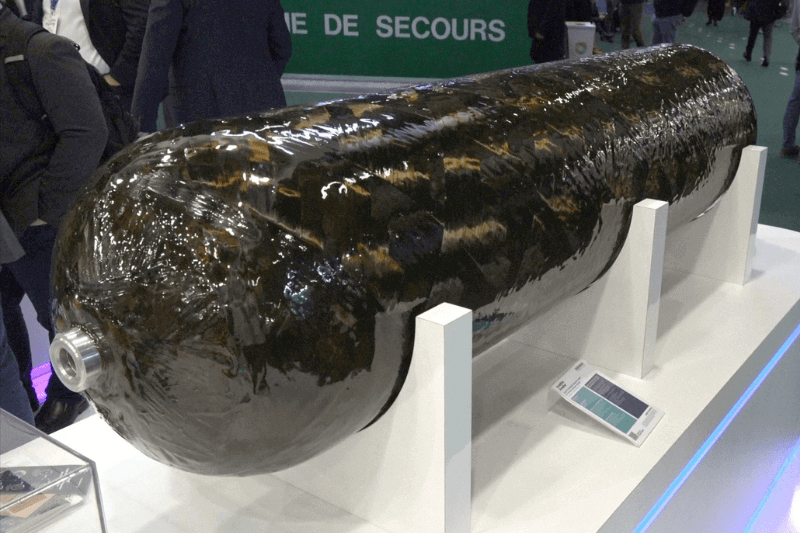
Composed of a composite structural shell (primarily carbon fiber) and an internal polymer liner (thermoplastic or thermoset), “Type IV” tanks are currently the most widely used solution for hydrogen storage. While the composite structure provides high pressure resistance, the internal liner ensures hydrogen tightness. The specific properties of polymers significantly extend the tank’s fatigue life, and their low density reduces overall system weight. This material combination makes it possible to reach pressure levels of up to 700 bar.
Moreover, composite materials offer excellent strength-to-weight ratios as well as enhanced thermal and mechanical properties. The design of a Type IV hydrogen storage tank must take into account the intended application, test pressure, external environment (including potential mechanical impacts and chemical degradation), lifecycle considerations, and safety factors defined for both stationary and mobile applications. Failure modes and operating conditions must also be carefully considered during material selection.
Given these factors, composite materials clearly represent a leading solution for designing high-pressure hydrogen storage tanks. However, the manufacturing process is equally critical.
Type IV tanks are generally manufactured using the filament winding process, which enables the production of components capable of withstanding high internal pressures. The process consists of winding resin-impregnated carbon fibers around a rotating mandrel.
And What About Québec?
In 2024, a consortium composed of COALIA, the Centre de développement des composites du Québec (CDCQ), and the Université de Sherbrooke initiated the design and development of Québec’s first Type IV high-pressure hydrogen storage tank using filament winding technology. The project is supported by several Québec-based green hydrogen producers, including CHARBONE Hydrogen and Harnois Énergies.
The knowledge and expertise gained through this initiative can be applied across multiple sectors where green hydrogen is emerging as a promising energy carrier. Furthermore, the development of such technologies will enable the province not only to advance its energy transition and align with its GHG reduction targets, but also to strengthen its international positioning while opening new market opportunities for Québec manufacturers.
By Fanny Charreteur and Mostafa Chamoumi, special collaboration*
*Mostafa Chamoumi is Project Manager – Plastics Sector at COALIA.
This article has not undergone thorough linguistic review. It may therefore contain some spelling and syntax errors. Rest assured that the nature of the content and information presented is not affected.

